Index
This topic area covers statistics and information relating to breastfeeding in Hull including local strategic need and service provision.
This page contains information from the Office for Health Improvement & Disparities’ Fingertips. Information is taken ‘live’ from the site so uses the latest available data from Fingertips and displays it on this page. As a result, some comments on this page may relate to an earlier period of time until this page is next updated (see review dates at the end of this page).
Summary Infographic
Headlines
- There are many benefits both to baby and mother in relation to breastfeeding.
- There are many costs savings associated with breastfeeding both to the family through not buying formula milk and to the NHS through fewer cases and admissions of otitis media, gastroenteritis and asthma.
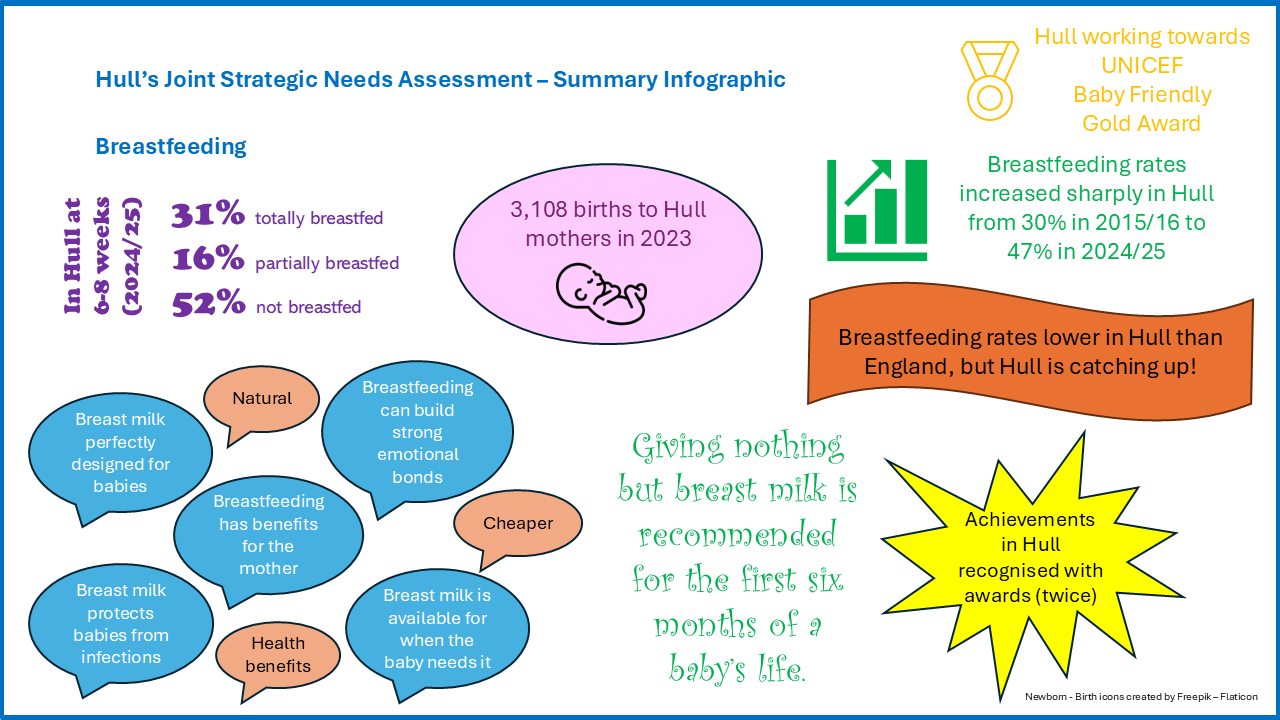
- In 2024/25, 46.6% of babies were being totally or partially breast fed in Hull at their 6-8 weeks review which was lower than England (55.6%). Nevertheless, the rate in Hull has increased sharply in the last 2-3 years. In 2015/16, 30.1% of babies in Hull were totally or partially breastfed, but this only increased gradually to 34.2% in 2021/22 with much larger increases in the last 2-3 years (36.5% for 2022/23, 41.6% for 2023/24 and 46.6% for 2024/25).
The Population Affected – Why Is It Important?
The NHS gives the benefits of breastfeeding:
- breast milk is perfectly designed for a mother’s baby;
- breast milk protects babies from infections and diseases;
- breastfeeding provides health benefits for the mother;
- breast milk is available for a baby whenever a baby needs it; and
- breastfeeding can build a strong emotional bond between mother and baby.
Formula milk does not provide the same protection from illness and does not give the mother with the same health benefits. Furthermore, breastfeeding has long-term benefits for a baby, lasting right into adulthood. The NHS also state that any amount of breast milk has a positive effect, and that the longer a mother breastfeeds her baby, the longer the protection lasts and the greater the benefits.
Breastfeeding can help to reduce a baby’s risk of:
- infections, with fewer visits to hospital as a result;
- diarrhoea and vomiting, with fewer visits to hospital as a result;
- sudden infant death syndrome;
- obesity; and
- cardiovascular disease in adulthood.
Giving nothing but breast milk is recommended for about the first 6 months (26 weeks) of a baby’s life. After that, giving breast milk alongside solid foods for as long as a mother and baby wants helps a baby grow and develop healthily. Breast milk adapts as a baby grows to meet the baby’s changing needs.
Breastfeeding and making breast milk also has health benefits for the mother. The more a mother breastfeeds, the greater the benefits. Breastfeeding lowers the mother’s risk of breast cancer, ovarian cancer, osteoporosis, cardiovascular disease, and obesity.
Furthermore, breastfeeding also is considerably cheaper as it avoids the need to buy infant formula milk.
Nationally, if all babies were breastfed, it is estimated that £35 million each year could be saved by the NHS due to treating gastroenteritis alone. Even if breastfeeding prevalence at 6 months was increased by 10%, it is estimated that the NHS could save at least £5.6 million over 4-5 years due to the prevention of cases of otitis media, gastroenteritis and asthma. The cost savings in Hull from these three conditions is estimated to be £33,945 per year (although not all savings will be realised in the first year).
However, whilst breastfeeding is the healthiest and most natural way to feed a baby, it does not mean it is always straightforward. Babies are all different: some will feed frequently and settle afterwards, some will feed most of the time, and others may be sleepy and need reminding to feed. Breastfeeding support may be required and there is specialist help for those who need it.
The Hull Picture
Percentage of Breastfeeding in Hull
The percentage of babies who were being breastfed totally or partially at their 6-8 week review was also lower in Hull compared to England in 2024/25 with 46.6% of babies breastfed in Hull compared to just over half of babies across England (55.6%).
Not all local authorities has a sufficiently high percentage of 6-8 week checks completed within time, so breastfeeding rates are not available for all local authorities.
Compared with benchmark
| Indicator | Period | England | Yorkshire and the Humber region (statistical) | Kingston upon Hull | East Riding of Yorkshire | North East Lincolnshire | North Lincolnshire | York | North Yorkshire UA | Barnsley | Doncaster | Rotherham | Sheffield | Bradford | Calderdale | Kirklees | Leeds | Wakefield |
|---|---|---|---|---|---|---|---|---|---|---|---|---|---|---|---|---|---|---|
Breastfeeding prevalence at 6 to 8 weeks (Persons 6-8 weeks) | 2024/25 | 55.6 | - | 46.6 | 54.3 | 38.0 | 40.6 | - | 55.9 | 38.3 | 39.9 | 44.1 | - | - | - | - | - | 38.5 |
| Indicator | Period | England | Yorkshire and the Humber region (statistical) | Kingston upon Hull | East Riding of Yorkshire | North East Lincolnshire | North Lincolnshire | York | North Yorkshire UA | Barnsley | Doncaster | Rotherham | Sheffield | Bradford | Calderdale | Kirklees | Leeds | Wakefield |
|---|---|---|---|---|---|---|---|---|---|---|---|---|---|---|---|---|---|---|
Breastfeeding prevalence at 6 to 8 weeks (Persons 6-8 weeks) | 2024/25 | 55.6 | - | 46.6 | 54.3 | 38.0 | 40.6 | - | 55.9 | 38.3 | 39.9 | 44.1 | - | - | - | - | - | 38.5 |
Breastfeeding rates at 6-8 weeks increased gradually from 30.1% in 2015/16 to 34.2% in 2021/22. However, between 2021/22 and 2024/25, there has been a sharp increase from 34.2% to 46.6%.
This has resulted in the inequalities gap between Hull and England decreasing considerably. Breastfeeding rates in Hull were approximately 30% lower than England between 2015/16 and 2021/22, but are only 16% lower for 2024/25.
Compared with benchmark
Breastfeeding prevalence at 6 to 8 weeks (Persons 6-8 weeks)
|
Period
|
Kingston upon Hull |
Yorkshire and the Humber region (statistical)
|
England
|
||||
|---|---|---|---|---|---|---|---|
|
Count
|
Value
|
95%
Lower CI |
95%
Upper CI |
||||
| 2015/16 | • | 1171 | 30.1% | 28.7% | 31.6% | - | 43.2% |
| 2016/17 | • | 1236 | 30.1% | 28.7% | 31.5% | - | 44.4% |
| 2018/19 | • | 1240 | 32.6% | 31.2% | 34.1% | - | 46.2% |
| 2019/20 | • | 1223 | 33.7% | 32.2% | 35.3% | - | 48.0% |
| 2020/21 | • | 1239 | 34.8% | 33.3% | 36.4% | - | 47.6% |
| 2021/22 | • | 1199 | 34.2% | 32.7% | 35.8% | - | 49.2% |
| 2022/23 | • | 1125 | 36.5% | 34.8% | 38.2% | - | 49.2% |
| 2023/24 | • | 1262 | 41.6% | 39.9% | 43.4% | - | 52.7% |
| 2024/25 | • | 1419 | 46.6% | 44.8% | 48.3% | - | 55.6% |
Source: OHID, based on interim reporting data for universal health visiting services
Further information is available in the national dataset on breastfeeding rates. In Hull for 2024/25 there were 3,048 infants in Hull who were due a 6-8 week review with breastfeeding information recorded at 6-8 week for 2,973 (97.5%) of them. Out of these 2,973 infants, 935 (31.4%) were totally breastfed, 484 (16.3%) were partially breastfed and 1,554 (52.3%) were not breastfed at all. As above, this meant that 1,419 (47.7%) were totally or breastfed at 6-8 weeks. This compares with 91.1% with measurements for England, and of these, 38.4% totally breastfed, 22.3% partially breastfed and 39.3% not breastfed at all. These figures differ slightly from those above used in Fingertips as the percentages in Fingertips are reported out of the numbers due a review rather than the numbers with breastfeeding status recorded. With the data on Fingertips, it is assumed that the numbers with breastfeeding status not known will have the same percentage breastfeeding status as those whose breastfeeding status is known. This might not be the case. So both sets of figures are presented within Hull’s Joint Strategic Needs Assessment.
In Depth Assessment of Breastfeeding in Hull 2022
In July 2022, the prevalence of breastfeeding was examined in more detail including an assessment of the differences across the electoral wards in Hull.
Strategic Need and Service Provision
The National Institute of Health and Clinical Excellence (NICE) has the following guidance to support breastfeeding:
- General principles about babies’ feeding
- Giving information about breastfeeding
- Role of the healthcare professional supporting breastfeeding
- Supporting women to breastfeed
- Assessing breastfeeding
- Supporting continued breastfeeding
- Supporting continued breastfeeding after returning to work or study
https://www.nice.org.uk/guidance/ng194/chapter/Recommendations
It is necessary to encourage as many women to breastfeed their babies as possible by explaining the advantages, and by offering advice and support, both prenatally and post-natal. This involves providing quality information, implementing a structured programme of activity using the UNICEF Baby Friendly Initiative as a minimum, training healthcare and support staff to be confident and competent to support breastfeeding mothers, and supporting all mothers and increasing their confidence to breastfeed. Birth preparation and parent education services provide antenatal education and supports improving breastfeeding rates. Hull University Teaching Hospitals NHS Trust is already a Unicef Baby Friendly Accredited Hospital.
In 2016 the UK Committee for UNICEF (UNICEF UK) launched new Achieving Sustainability standards. Services that are currently accredited as Baby Friendly will be eligible to be assessed against these standards at their next scheduled re-assessment. If the service meets all of the criteria, they will then be accredited as a Gold Baby Friendly service.
Services that are fully accredited as Baby Friendly can consider going for Gold. The Award is designed as the next step for accredited services whose audit results consistently show that the Baby Friendly standards are largely being met. The Gold assessment can be carried out following the next planned re-assessment.
Working towards the Gold Award acts as an incentive for services to properly embed the Achieving Sustainability standards and so consolidate and protect all the hard work that has gone into achieving Baby Friendly accreditation. This will mean that future generations of babies, their mothers and families will still continue to experience Baby Friendly standards of care. The Award will be a recognition that the service is not only implementing the Baby Friendly Initiative standards, but that they also have the leadership, culture and systems to maintain this over the long term.
It is an aspiration that the following services achieve the Gold standard of the UNICEF Baby Friendly standards:
- Local Health Visiting Service
- Family Hubs
- Local Midwifery and Neonatal Wards
- Hull University (school for Midwifery and Health Visiting)
A recent Breastfeeding Needs Assessment for Hull highlighted that the greatest drop in breastfeeding rates occurs in the first two weeks following the child’s birth. Ensuring families who chose to breastfeed locally are supported, a team of Baby Feeding Practitioners were recruited to provide support in the first few weeks following birth, this was complemented by the expansion of the Infant feeding team within the Health Visiting Service as well as the Breastfeeding Peer Support Service.
The Needs Assessment also found one of the highest reasons women decided to stop breastfeeding was due to having to return to work. Women returning to work should be supported to continue to breastfeed through policies which are designed to support women returning to work whilst breastfeeding.
Hull City Council and partners have been recognised for their work on breastfeeding locally at the Yorkshire and Humber Infant Feeding Awards, where Hull City Council has gained the award for the most Sustainable Local Authority for Infant Feeding two years in a row.
As a result, Hull has seen record increases in breastfeeding rates at 10 days and 6-8 weeks, to ensure momentum remains, a focus should now be on initiation rates of breastfeeding, ensuring every family in the city understand the benefits of breastfeeding, whilst ensuring where breastfeeding is chosen, they are supported to do so.
Resources
NHS. Benefits of breastfeeding. https://www.nhs.uk/conditions/pregnancy-and-baby/benefits-breastfeeding/
The Office for Health Improvement & Disparities’ Fingertips: https://fingertips.phe.org.uk/
The Office for Health Improvement & Disparities. Breastfeeding at 6 to 8 weeks after birth: annual data April 2024 to March 2025. Breastfeeding at 6 to 8 weeks: data for 2024 to 2025 – GOV.UK
National Institute of Health and Clinical Excellence guidance: https://www.nice.org.uk/guidance/cg37/chapter/1-Recommendations#infant-feeding
Updates
This page was last updated / checked on 23 April 2026.
This page is due to be updated / checked in August 2026.