Index
This topic area covers statistics and information relating to children with special educational needs or disabilities in Hull including local strategic need and service provision. Further information relating Learning Disabilities is also available under Vulnerable Groups which includes information on prevalence among both children and adults, as well as the numbers of people with learning disabilities using council services, and the number of people with diagnosed learning disabilities who are in appropriate accommodation and who are employed. Further information can also be found on Neurodiversity under Health Factors within both Children and Young People and Adults.
This page contains information from the Office for Health Improvement & Disparities’ Fingertips. Information is taken ‘live’ from the site so uses the latest available data from Fingertips and displays it on this page. As a result, some comments on this page may relate to an earlier period of time until this page is next updated (see review dates at the end of this page).
Headlines
- A child or young person has Special Educational Needs or Disability (SEND) if they have a learning difficulty or disability which needs additional or different provision than most children of the same age.
- Further to the Children and Families Act 2014, children and young people (under the age of 25 years) who have special educational needs may have an Education, Health and Care Plan (EHCP), developed by all professionals and the family working together, to address all needs that a child or young person has within education, health and care.
- Most children with SEND are supported in school without the requirement of an EHCP (which brings additional funding) All schools must provide what is known as ‘SEN Support’ before they consider an EHCP.
- The overall number of school aged children with an Education, Health and Care Plan (EHCP) or with Special Educational Needs Support (SEN Support) steadily increased in Hull between 2015/16 and 2022/23 from 17.3% to 18.3% with larger increases in the last two years. For 2024/25, 9,305 (21.1%) of the 44,100 pupils in Hull have an EHCP or require SEN Support which is higher than England and the region (both 19.6%). Some of the increase could be due to increased awareness, testing and better recording.
- The prevalence of special educational needs is higher amongst disadvantaged pupils when compared non-disadvantaged or ‘other’ pupils.
- SEND needs fall into four broad categories: Communication and Interaction (for example, speech and language needs); Cognition and Learning (for example, difficulties with memory or a specific difficult affecting one part of their learning, such as reading); Social, Emotional and Mental Health difficulties (for example, difficulty in managing relationships); sensory or physical needs (for example, visual or hearing impairments)
- Speech, language and communication needs, moderate learning difficulty, specific learning difficulty and social, emotional and mental health were the most commonly identified primary needs of pupils with SEN in Hull.
- Boys were more likely than girls to have an EHC plan and also more likely to require SEN Support.
The Population Affected – Why Is It Important?
Every child deserves to lead a fulfilling life and the opportunity to flourish in school, regardless of their Special Educational Needs and Disabilities (SEND). When learning difficulties are not picked up and met early, they can go onto impact negatively on self esteem, on confidence, engagement in learning and on life chances. In addition, children develop quickly in the early years, so the earlier the intervention, the greater the impact it will have.
Following the Children and Families Act 2014, there are two levels of Special Educational Needs (SEN) provision in schools. Children and young people (under the age of 25 years) who have SEN may have an Education, Health and Care (EHC) plan, developed by all professionals and the family working together, to address all needs that a child or young person has within education, health and care. An EHC plan is the highest level of SEN provision. Children with a learning disability assessment should have an EHC plan.
Lower levels of SEN are addressed by pupils being in receipt of SEN Support. Under the Children and Families Act 2014, all pupils with SEN must have an identified primary need.
All early years and education providers are responsible for doing their best to ensure that special educational needs are met. This involves identifying needs early and ensuring that parents, children and young people are at the centre of decision making. All teachers must have high aspirations for children with SEND. The school Special Educational Needs Coordinator (SENCO) has a key role, assessing, planning and reviewing progress, alongside the child and their parents.
The Hull Picture
Just under a quarter (23.9% in 2024-25) of pupils with an EHCP in the city attend specialist provision (special schools) with more (43.1% in 2024-25) attending a mainstream school. The number of pupils attending a special school with a SEN/EHCP has been steadily increasing, although with some annual variation. In the 2024-25 academic year there were 776 pupils with an EHCP in Hull special schools. The number of pupils attending a Hull mainstream school with a SEN/EHCP was relatively stable up until the changeover and number began to increase from 2018 also. In the 2024-25 academic year there were 1,398 pupils in Hull attending a mainstream school with an EHCP.
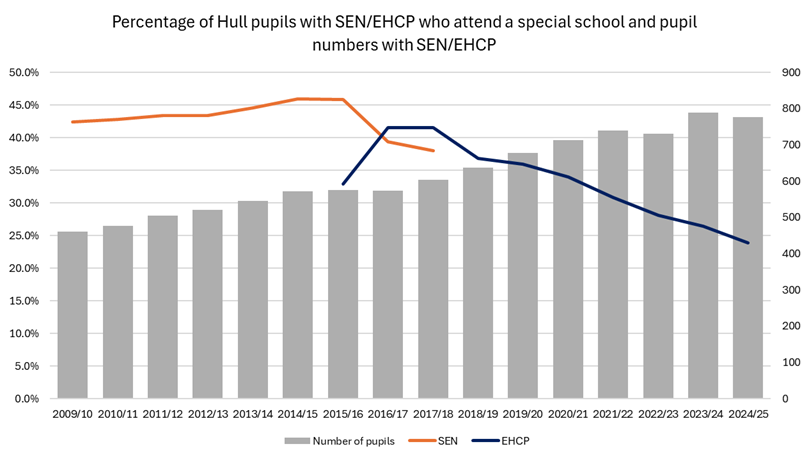
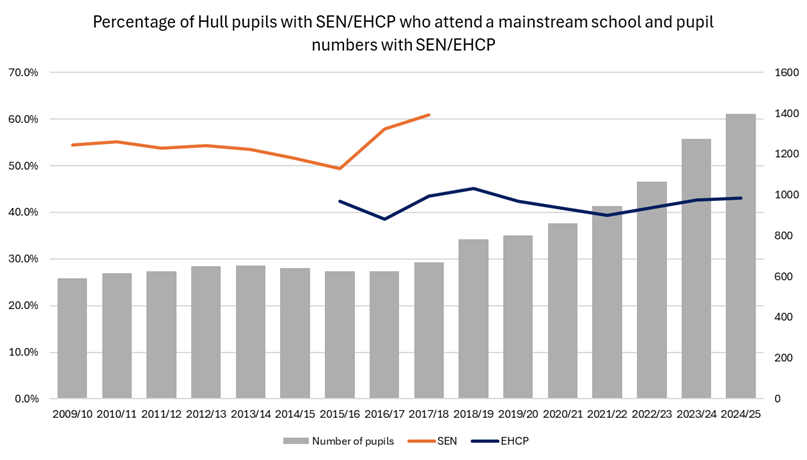
The Office for Health Improvement & Disparities’ Fingertips presents information on the percentages of school children who have Education, Health and Care (EHC) Plans or are on SEN Support.
For the 2024/25 school year, a statistically significantly higher percentage of children in Hull had special educational needs (21.1%) compared to England and the region (both 19.6%). The percentage in Hull is second highest in the region after Rotherham.
Compared with benchmark
| Indicator | Period | England | Yorkshire and the Humber region (statistical) | Kingston upon Hull | East Riding of Yorkshire | North East Lincolnshire | North Lincolnshire | York | Barnsley | Doncaster | Rotherham | Sheffield | Bradford | Calderdale | Kirklees | Leeds | Wakefield |
|---|---|---|---|---|---|---|---|---|---|---|---|---|---|---|---|---|---|
Pupils with special educational needs (SEN) (Persons School age) | 2024/25 | 19.6 | 19.6 | 21.1 | 18.2 | 19.5 | 19.9 | 16.1 | 18.6 | 18.2 | 23.5 | 20.4 | 19.4 | 19.7 | 19.2 | 19.8 | 20.2 |
| Indicator | Period | England | Yorkshire and the Humber region (statistical) | Kingston upon Hull | East Riding of Yorkshire | North East Lincolnshire | North Lincolnshire | York | Barnsley | Doncaster | Rotherham | Sheffield | Bradford | Calderdale | Kirklees | Leeds | Wakefield |
|---|---|---|---|---|---|---|---|---|---|---|---|---|---|---|---|---|---|
Pupils with special educational needs (SEN) (Persons School age) | 2024/25 | 19.6 | 19.6 | 21.1 | 18.2 | 19.5 | 19.9 | 16.1 | 18.6 | 18.2 | 23.5 | 20.4 | 19.4 | 19.7 | 19.2 | 19.8 | 20.2 |
The rates in Hull have steadily increased in Hull between 2015/16 and 2022/23 from 17.3% to 18.3% although the increases in the last two years have been greater increasing to 19.7% for 2023/24 and to 21.1% for 2024/25. Some of the increase could be due to increased awareness, testing and better recording.
Across the region and England, the percentages have also increased, and at a faster rate between 2015/16 and 2022/23 so the difference between Hull and England reduced. The increases in the last two years have been slightly greater in Hull though.
There were 9,305 pupils in Hull with EHC Plans or requiring SEN Support in the 2024/25 school year out of the estimated 44,100 pupils attending Hull schools.
Compared with benchmark
Pupils with special educational needs (SEN) (Persons School age)
|
Period
|
Kingston upon Hull |
Yorkshire and the Humber region (statistical)
|
England
|
||||
|---|---|---|---|---|---|---|---|
|
Count
|
Value
|
95%
Lower CI |
95%
Upper CI |
||||
| 2015/16 | • | 6883 | 17.3% | 16.9% | 17.7% | 13.9% | 14.4% |
| 2016/17 | • | 6831 | 16.7% | 16.3% | 17.0% | 14.0% | 14.4% |
| 2017/18 | • | 7110 | 17.0% | 16.6% | 17.4% | 14.5% | 14.6% |
| 2018/19 | • | 7475 | 17.5% | 17.2% | 17.9% | 15.0% | 14.9% |
| 2019/20 | • | 7824 | 18.1% | 17.8% | 18.5% | 15.4% | 15.5% |
| 2020/21 | • | 7955 | 18.4% | 18.0% | 18.8% | 15.7% | 15.8% |
| 2021/22 | • | 8028 | 18.3% | 17.9% | 18.7% | 16.4% | 16.5% |
| 2022/23 | • | 8110 | 18.3% | 17.9% | 18.7% | 17.3% | 17.3% |
| 2023/24 | • | 8774 | 19.7% | 19.3% | 20.1% | 18.3% | 18.4% |
| 2024/25 | • | 9305 | 21.1% | 20.7% | 21.4% | 19.6% | 19.6% |
Source: Department for Education
From the national school league tables for the 2023-2024 academic year, the prevalence of EHC Plans and SEN support within Hull’s schools differ widely as follows:
- All 807 pupils from Hull’s six special schools have EHC Plans.
- Across Hull’s 71 state-funded primary schools, the percentage of pupils with EHC Plans ranges from 0.3% to 11.2%, and the percentage of pupils with SEN Support ranges from 6.6% to 27.5%.
- Across Hull’s 13 state-funded secondary schools, the percentage of pupils with EHC Plans ranges from 0.7% to 4.0%, and the percentage of pupils with SEN Support ranges from 2.3% to 18.4%.
The following mainstream primary schools have more than 5% of their pupils on EHC Plans:
- Appleton Primary School (5.6%)
- Victoria Dock Primary School (5.9%)
- Spring Cottage Primary School (6.7%)
- Ings Primary School (7.4%)
- Rokeby Park Primary School (7.8%)
- Dorchester Primary School (8.5%)
- Christopher Pickering Primary School (9.0%)
- Wansbeck Primary School (11.2%)
The following mainstream primary schools have more than 20% of their pupils with SEN Support:
- Chiltern Primary School (20.1%)
- The Green Way Academy (20.4%)
- Stockwell Academy (20.5%)
- Westcott Primary School (21.1%)
- Griffin Primary School (21.3%)
- Wheeler Primary School (21.3%)
- Bude Park Primary School (21.6%)
- Adelaide Primary School (22.7%)
- Wold Academy (23.1%)
- The Parks Primary Academy (23.4%)
- Stepney Primary School (24.2%)
- Woodland Primary School (24.4%)
- Rokeby Park Primary School (27.5%)
The following mainstream secondary schools have 3% or more of their pupils on EHC Plans:
- Winifred Holtby Academy (3.0%)
- The Marvell College (3.9%)
- Kelvin Hall School (4.0%)
The following mainstream secondary schools have more than 15% of their pupils with SEN Support:
- Archbishop Sentamu Academy (15.6%)
- Malet Lambert (15.7%)
- Newland School for Girls (16.2%)
- Sirius Academy North (17.0%)
- The Boulevard Academy (17.2%)
- Sirius Academy West (18.2%)
- Winifred Holtby Academy (18.4%)
There is increasing evidence to suggest that the demand for assessment towards EHC Plans is increasing both locally and nationally. The increase is less evident for Hull. However, there is bound to be an increase from 2014 when they were first introduced. For Hull, the absolute numbers are lower for 2021 and 2022, which might be due to the COVID-19 pandemic, but numbers did not change much across the region or England during these two years. Hull has been inconsistent in producing plans within the statutory time frame of 20 weeks.
| Year | Hull (N) | Hull (%) | Y&H (N) | Y&H (%) | England (N) | England (%) |
| 2014 | 0 | – | 50 | 62.5 | 836 | 61.5 |
| 2015 | 4 | 17.4 | 1,181 | 61.9 | 13,451 | 54.6 |
| 2016 | 110 | 48.9 | 1,875 | 57.1 | 20,045 | 55.7 |
| 2017 | 172 | 90.1 | 2,413 | 60.1 | 25,302 | 61.3 |
| 2018 | 55 | 20.5 | 2,725 | 59.8 | 28,178 | 58.0 |
| 2019 | 274 | 89.0 | 3,282 | 71.1 | 31,313 | 58.7 |
| 2020 | 256 | 87.4 | 3,622 | 68.9 | 32,863 | 55.6 |
| 2021 | 74 | 23.2 | 3,502 | 64.9 | 35,470 | 57.9 |
| 2022 | 96 | 27.1 | 3,640 | 61.2 | 31,226 | 47.7 |
| 2023 | 138 | 30.4 | 4,444 | 55.5 | 39,784 | 49.1 |
Number of EHC Plans (including exceptions) and percentages that were produced within the statutory deadline of 20 weeks of request.
Strategic Need and Service Provision
As a good education is very important for future health and wellbeing, it is essential that children are ready for school, and that children and young people are able to maximise their achievements whilst at school in order that they can have good employment prospects and fulfilling lives. Some will need input from specialist services to reach their potential, such as Speech and Language Therapy. Local Authorities must ensure their ‘Local Offer’ informs parents what services are available and how to access them. Parents should also be included in decision-making about services, as equal partners.
Resources
The Office for Health Improvement & Disparities’ Fingertips: https://fingertips.phe.org.uk/
Updates
This page was last updated / checked on 3 March 2026.
This page is due to be updated / checked in March 2026.