Index
This topic area covers statistics and information relating to under 18 conceptions in HThis topic area covers statistics and information relating to under 18 conceptions in Hull including local strategic need and service provision. Further information relating to the mothers of all ages is available within Pregnancy and Maternal Health, and Births and Infant Health under Maternal Health and Infants within Children and Young People. Information on Sexual and Reproductive Health is given under Health Factors within Adults.
This page contains information from the Office for Health Improvement & Disparities’ Fingertips. Information is taken ‘live’ from the site so uses the latest available data from Fingertips and displays it on this page. As a result, some comments on this page may relate to an earlier period of time until this page is next updated (see review dates at the end of this page).
Summary Infographic
Headlines
- Although it can be positive for many young women, teenage pregnancy is often associated with poorer outcomes for both young parents and their children.
- The rate of under 18 and under 16 conceptions in Hull have both halved since 2009.
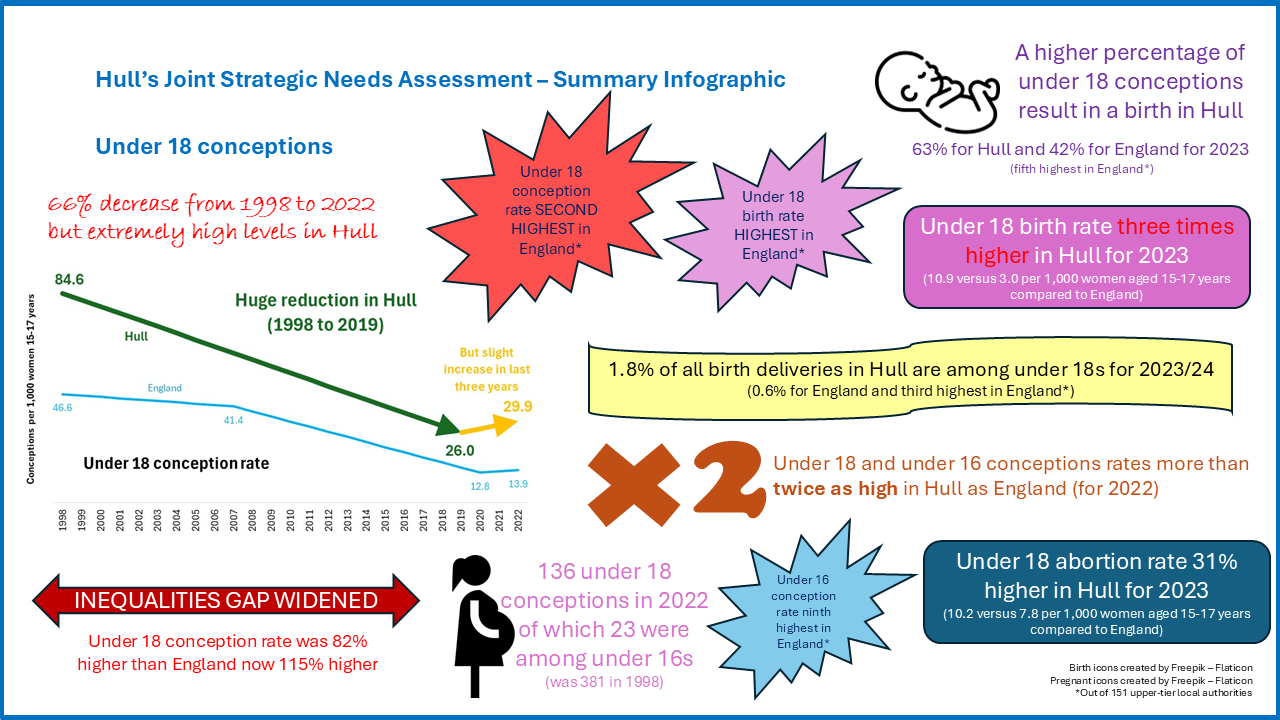
- Despite this decrease, the rate of under 18 conceptions in Hull in 2022 is significantly higher than England (29.9 compared to 13.9 per 1,000 women aged 15-17 years), and the rate in Hull increased slightly in the last three years.
- During 2022, there were 136 under 18 conceptions (23 of which were under 16 years) in Hull considerably fewer than the 381 under 18 conceptions in 1998.
- In 2022, 36.8% of the under 18 conceptions led to an abortion which was considerably lower than for England (58.2%).
- In 2023/24, there were 55 delivery episodes among Hull mothers were aged under 18 years representing 1.8% of all deliveries. This was three times higher than England (0.6%). Whilst the percentage in Hull has decreased considerably since 2010/11 when there were 100 delivery episodes among Hull mothers aged under 18 years representing 2.8% of all births to a low of 35 deliveries (1.1% of all delivery episodes) in 2019/20, the percentage has increased in Hull between 2019/20 and 2023/24.
The Population Affected – Why Is It Important?
Teenage conceptions usually refers to conceptions to women who are under the age of 18. Although it can be positive for many young women, teenage pregnancy is often associated with poorer outcomes for both young parents and their children.
Teenage pregnancy is a complex social issue with a number of contributing risk factors including living in poverty, low educational attainment or not finishing education, absenteeism, not being in education, employment or training (NEET), involvement of social care, low self-esteem, early sexual activity and poor contraception use. There are also disproportionately poor outcomes for those who do become teenage parents. At age 30, teenage mothers are 22% more likely to be living in poverty and 20% more likely to have no qualifications than mothers giving birth aged 24 or over and are much less likely to be employed or living with a partner. There is a growing recognition that socio-economic disadvantage can be both a cause and a consequence of teenage parenthood.
The Hull Picture
Delays in National Data Relating to Under 18 Conception Rates
The publication date for the national under 18 conception data has been delayed in the last few years due to problems with data flows with the abortion data. A few years ago, the data for under 18 conceptions that occurred during a specific calendar year was published in February or March around 14-15 months after the end of the calendar year. So previously, data relating to conceptions that occurred during the 2024 calendar year would have been published around February or March 2026.
However, the national data for 2023 has not yet been released.
There are relatively long delays in the data already. Women who conceived at the end of December might not have had their first booking maternity appointment until several weeks into the New Year, and some women may take longer to approach healthcare, particularly under 18s. It is also necessary to wait until the outcome of the conception (abortion or birth or other outcome) is known as this is recorded in the national dataset relating to the under 18 conceptions. In theory, this information should be available after around nine months, but in practice, as the conception, birth and abortion data needs to be matched, checked and verified first, this will take longer.
Under 18 and Under 16 Conception Rates
The conception rate of under 18 conceptions is given as the number of conceptions per 1,000 females aged 15-17 years, and the conception rate for the under 16s relate to number of under 16 conceptions per 1,000 females aged 13-15 years.
In 2022, both the under 18 and under 16 conception rates in Hull were more than twice as high as the rate for England with 29.9 conceptions per 1,000 women aged 15-17 years for Hull compared to 13.9 conceptions per 1,000 women aged 15-17 years for England among under 18s, and 4.7 conceptions per 1,000 women aged 13-15 years for Hull compared to 2.2 conceptions per 1,000 women aged 13-15 years for England among under 16s.
A more detailed analysis is given in the report below which highlights the high rate of under 18 conceptions in Hull relative to other local authorities in England, and differences across Hull.
Among the under 18 conceptions, a higher percentage lead to an abortion in England (58.2%) compared to Hull (36.8%) for 2022.
Compared with benchmark
| Indicator | Period | England | Yorkshire and the Humber region (statistical) | Kingston upon Hull | East Riding of Yorkshire | North East Lincolnshire | North Lincolnshire | York | North Yorkshire UA | Barnsley | Doncaster | Rotherham | Sheffield | Bradford | Calderdale | Kirklees | Leeds | Wakefield |
|---|---|---|---|---|---|---|---|---|---|---|---|---|---|---|---|---|---|---|
Under 18s conception rate (Female <18 yrs) | 2022 | 13.9 | 17.7 | 29.9 | 12.1 | 24.7 | 19.0 | 13.6 | 11.6 | 20.4 | 22.0 | 19.3 | 17.0 | 16.0 | 15.2 | 12.5 | 20.9 | 20.7 |
Under 18s conceptions leading to abortion (Female <18 yrs) | 2022 | 58.2 | 48.7 | 36.8 | 52.3 | 43.1 | 36.4 | 61.0 | 53.8 | 52.4 | 45.3 | 36.7 | 44.4 | 55.5 | 55.2 | 52.0 | 54.0 | 45.5 |
Under 16s conception rate (Female <16 yrs) | 2022 | 2.2 | 3.1 | 4.7 | 1.1 | 3.7 | 4.0 | 2.0 | 1.5 | 3.6 | 4.4 | 2.7 | 3.2 | 4.0 | 2.8 | 2.2 | 3.0 | 3.9 |
| Indicator | Period | England | Yorkshire and the Humber region (statistical) | Kingston upon Hull | East Riding of Yorkshire | North East Lincolnshire | North Lincolnshire | York | North Yorkshire UA | Barnsley | Doncaster | Rotherham | Sheffield | Bradford | Calderdale | Kirklees | Leeds | Wakefield |
|---|---|---|---|---|---|---|---|---|---|---|---|---|---|---|---|---|---|---|
Under 18s conception rate (Female <18 yrs) | 2022 | 13.9 | 17.7 | 29.9 | 12.1 | 24.7 | 19.0 | 13.6 | 11.6 | 20.4 | 22.0 | 19.3 | 17.0 | 16.0 | 15.2 | 12.5 | 20.9 | 20.7 |
Under 18s conceptions leading to abortion (Female <18 yrs) | 2022 | 58.2 | 48.7 | 36.8 | 52.3 | 43.1 | 36.4 | 61.0 | 53.8 | 52.4 | 45.3 | 36.7 | 44.4 | 55.5 | 55.2 | 52.0 | 54.0 | 45.5 |
Under 16s conception rate (Female <16 yrs) | 2022 | 2.2 | 3.1 | 4.7 | 1.1 | 3.7 | 4.0 | 2.0 | 1.5 | 3.6 | 4.4 | 2.7 | 3.2 | 4.0 | 2.8 | 2.2 | 3.0 | 3.9 |
In Hull, the rate of under 18 conceptions has decreased significantly since 1998. The decrease in Hull has been at a faster rate than the decrease nationally thus reducing the inequalities gap between Hull and England, although the rates in Hull and England have increased in the last three years, with the larger increases in Hull increasing the inequalities gap. After these increases, the rate in Hull in 2022 was 115% higher than England.
During 2022, there were 136 under 18 conceptions in Hull, the third year of increases, but still considerably lower than the 381 under 18 conceptions in 1998.
Compared with benchmark
Under 18s conception rate (Female <18 yrs)
|
Period
|
Kingston upon Hull |
Yorkshire and the Humber region (statistical)
|
England
|
||||
|---|---|---|---|---|---|---|---|
|
Count
|
Value
|
95%
Lower CI |
95%
Upper CI |
||||
| 1998 | • | 381 | 84.6 | 76.3 | 93.5 | 53.1 | 46.6 |
| 1999 | • | 333 | 71.4 | 63.9 | 79.5 | 51.0 | 44.8 |
| 2000 | • | 350 | 73.2 | 65.7 | 81.3 | 47.9 | 43.6 |
| 2001 | • | 353 | 70.9 | 63.7 | 78.7 | 47.1 | 42.5 |
| 2002 | • | 339 | 66.6 | 59.7 | 74.1 | 47.2 | 42.8 |
| 2003 | • | 365 | 70.7 | 63.6 | 78.3 | 47.1 | 42.1 |
| 2004 | • | 412 | 82.3 | 74.5 | 90.6 | 48.1 | 41.6 |
| 2005 | • | 368 | 73.5 | 66.2 | 81.4 | 48.9 | 41.4 |
| 2006 | • | 359 | 69.3 | 62.3 | 76.9 | 48.0 | 40.6 |
| 2007 | • | 363 | 68.1 | 61.3 | 75.5 | 48.3 | 41.4 |
| 2008 | • | 348 | 66.8 | 60.0 | 74.2 | 47.1 | 39.7 |
| 2009 | • | 316 | 64.5 | 57.6 | 72.0 | 43.5 | 37.1 |
| 2010 | • | 261 | 56.2 | 49.6 | 63.5 | 39.9 | 34.2 |
| 2011 | • | 231 | 50.4 | 44.2 | 57.4 | 33.8 | 30.7 |
| 2012 | • | 176 | 39.4 | 33.8 | 45.6 | 31.7 | 27.8 |
| 2013 | • | 158 | 35.8 | 30.4 | 41.8 | 28.6 | 24.4 |
| 2014 | • | 164 | 39.2 | 33.4 | 45.6 | 26.4 | 22.9 |
| 2015 | • | 150 | 38.2 | 32.3 | 44.8 | 24.4 | 20.9 |
| 2016 | • | 114 | 30.4 | 25.1 | 36.5 | 22.0 | 19.0 |
| 2017 | • | 121 | 32.9 | 27.3 | 39.3 | 20.6 | 17.8 |
| 2018 | • | 111 | 29.7 | 24.4 | 35.7 | 19.5 | 16.6 |
| 2019 | • | 103 | 26.0 | 21.2 | 31.5 | 19.1 | 15.5 |
| 2020 | • | 111 | 26.6 | 21.9 | 32.0 | 16.3 | 12.8 |
| 2021 | • | 128 | 29.0 | 24.2 | 34.5 | 17.1 | 13.1 |
| 2022 | • | 136 | 29.9 | 25.1 | 35.3 | 17.7 | 13.9 |
Source: OHID, based on Office for National Statistics data
The percentage of under 18 conceptions that lead to an abortion has been consistently much lower in Hull over the entire period 1998 to 2022.
There were 136 under 18 conceptions in Hull during 2022 and 50 of them lead to an abortion.
Compared with benchmark
Under 18s conceptions leading to abortion (Female <18 yrs)
|
Period
|
Kingston upon Hull |
Yorkshire and the Humber region (statistical)
|
England
|
||||
|---|---|---|---|---|---|---|---|
|
Count
|
Value
|
95%
Lower CI |
95%
Upper CI |
||||
| 1998 | • | 123 | 32.3% | 27.8% | 37.1% | 36.5% | 42.4% |
| 1999 | • | 109 | 32.7% | 27.9% | 37.9% | 39.1% | 43.5% |
| 2000 | • | 119 | 34.0% | 29.2% | 39.1% | 38.9% | 44.8% |
| 2001 | • | 109 | 30.9% | 26.3% | 35.9% | 38.6% | 46.1% |
| 2002 | • | 108 | 31.9% | 27.1% | 37.0% | 39.9% | 45.8% |
| 2003 | • | 113 | 31.0% | 26.4% | 35.9% | 38.9% | 46.1% |
| 2004 | • | 133 | 32.3% | 27.9% | 36.9% | 38.8% | 46.0% |
| 2005 | • | 112 | 30.4% | 26.0% | 35.3% | 40.7% | 46.8% |
| 2006 | • | 124 | 34.5% | 29.8% | 39.6% | 43.5% | 48.8% |
| 2007 | • | 135 | 37.2% | 32.4% | 42.3% | 46.1% | 50.5% |
| 2008 | • | 134 | 38.5% | 33.5% | 43.7% | 44.3% | 49.7% |
| 2009 | • | 92 | 29.1% | 24.4% | 34.3% | 43.4% | 49.1% |
| 2010 | • | 101 | 38.7% | 33.0% | 44.7% | 45.3% | 50.3% |
| 2011 | • | 78 | 33.8% | 28.0% | 40.1% | 42.5% | 49.3% |
| 2012 | • | 48 | 27.3% | 21.2% | 34.3% | 41.3% | 49.1% |
| 2013 | • | 57 | 36.1% | 29.0% | 43.8% | 45.0% | 51.1% |
| 2014 | • | 70 | 42.7% | 35.4% | 50.3% | 46.0% | 51.1% |
| 2015 | • | 65 | 43.3% | 35.7% | 51.3% | 43.4% | 51.2% |
| 2016 | • | 36 | 31.6% | 23.8% | 40.6% | 44.3% | 51.8% |
| 2017 | • | 44 | 36.4% | 28.3% | 45.2% | 43.9% | 52.0% |
| 2018 | • | 46 | 41.4% | 32.7% | 50.7% | 46.4% | 53.0% |
| 2019 | • | 33 | 33.0% | 23.8% | 41.6% | 47.8% | 54.7% |
| 2020 | • | 34 | 31.5% | 22.8% | 39.7% | 47.1% | 53.0% |
| 2021 | • | 36 | 28.1% | 21.1% | 36.5% | 44.5% | 53.4% |
| 2022 | • | 50 | 36.8% | 29.1% | 45.1% | 48.7% | 58.2% |
Source: OHID, based on Office for National Statistics data
The under 16 conception rate has also fallen significantly over time. The rate in 2019 was the lowest it has been in Hull reaching 4.1 under 16 conceptions per 1,000 population aged 13-15 years. However, the rate increased in 2020 to 4.7 conceptions per 1,000 population aged 13-15 years, and increased further to 5.7 per 1,000 population aged 13-15 years in 2021, before decreasing again in 2022 to 4.7 per 1,000 population aged 13-15 years. The total numbers of conceptions are relatively small so it is anticipated that there will be some year-on-year variability (see Small Numbers).
In 2022, there were 23 under 16 conceptions in Hull which is around 60% lower than the number that occurred during 2009.
Compared with benchmark
Under 16s conception rate (Female <16 yrs)
|
Period
|
Kingston upon Hull |
Yorkshire and the Humber region (statistical)
|
England
|
||||
|---|---|---|---|---|---|---|---|
|
Count
|
Value
|
95%
Lower CI |
95%
Upper CI |
||||
| 2009 | • | 58 | 12.6 | 9.6 | 16.3 | 8.7 | 7.3 |
| 2010 | • | 52 | 11.7 | 8.8 | 15.4 | 8.3 | 6.7 |
| 2011 | • | 40 | 9.2 | 6.5 | 12.5 | 6.8 | 6.1 |
| 2012 | • | 32 | 7.7 | 5.2 | 10.8 | 6.8 | 5.6 |
| 2013 | • | 38 | 9.7 | 6.9 | 13.4 | 6.0 | 4.8 |
| 2014 | • | 34 | 9.1 | 6.3 | 12.7 | 5.5 | 4.4 |
| 2015 | • | 24 | 6.6 | 4.2 | 9.8 | 4.5 | 3.7 |
| 2016 | • | 18 | 4.8 | 2.9 | 7.6 | 4.0 | 3.0 |
| 2017 | • | 19 | 4.9 | 2.9 | 7.6 | 3.3 | 2.7 |
| 2018 | • | 21 | 5.1 | 3.2 | 7.8 | 3.2 | 2.5 |
| 2019 | • | 18 | 4.1 | 2.4 | 6.5 | 3.6 | 2.5 |
| 2020 | • | 21 | 4.7 | 2.9 | 7.2 | 2.9 | 2.1 |
| 2021 | • | 27 | 5.7 | 3.7 | 8.3 | 3.2 | 2.1 |
| 2022 | • | 23 | 4.7 | 3.0 | 7.1 | 3.1 | 2.2 |
Source: OHID, based on Office for National Statistics data
Under 18 Abortion Rate
The abortion rate among all young women under 18 years of age in Hull was higher than England for 2023 with 10.2 abortions per 1,000 women aged 15-17 years for Hull compared to 7.8 abortions per 1,000 women aged 15-17 years for England.
This will be a slightly different cohort of women to those mentioned above in relation to abortions associated with under 18 conceptions, as the time period will differ slightly. The abortions associated with under 18 conceptions will relate to calendar year when the under 18 conception occurred, but the overall rate of abortions among all under 18s will relate to the specified calendar year when the abortion occurred.
Compared with benchmark
| Indicator | Period | England | Yorkshire and the Humber region (statistical) | Kingston upon Hull | East Riding of Yorkshire | North East Lincolnshire | North Lincolnshire | York | North Yorkshire UA | Barnsley | Doncaster | Rotherham | Sheffield | Bradford | Calderdale | Kirklees | Leeds | Wakefield |
|---|---|---|---|---|---|---|---|---|---|---|---|---|---|---|---|---|---|---|
Under 18s abortions rate (Female <18 yrs) | 2023 | 7.8 | 9.0 | 10.2 | 10.1 | 13.2 | 6.8 | 7.9 | 6.8 | 11.0 | 9.2 | 7.3 | 9.2 | 7.8 | 10.3 | 7.2 | 9.7 | 13.1 |
| Indicator | Period | England | Yorkshire and the Humber region (statistical) | Kingston upon Hull | East Riding of Yorkshire | North East Lincolnshire | North Lincolnshire | York | North Yorkshire UA | Barnsley | Doncaster | Rotherham | Sheffield | Bradford | Calderdale | Kirklees | Leeds | Wakefield |
|---|---|---|---|---|---|---|---|---|---|---|---|---|---|---|---|---|---|---|
Under 18s abortions rate (Female <18 yrs) | 2023 | 7.8 | 9.0 | 10.2 | 10.1 | 13.2 | 6.8 | 7.9 | 6.8 | 11.0 | 9.2 | 7.3 | 9.2 | 7.8 | 10.3 | 7.2 | 9.7 | 13.1 |
As noted above, fewer of the under 18 conceptions result in an abortion in Hull, but as the number of under 18 conceptions is twice as high as England, the overall abortion rate among young women aged under 18 years has generally been higher in Hull compared to England, and is 30% higher for 2023.
There has been some year-on-year variability in the abortion rate among under 18s in Hull which has varied between 8.5 and 15.8 abortions per 1,000 women aged 15-17 years.
There has been an increase in the rate in the last two years for Hull, but an increase has also occurred across the region and England.
During 2023, 50 women who were aged under 18 years had abortions in Hull.
Compared with benchmark
Under 18s abortions rate (Female <18 yrs)
|
Period
|
Kingston upon Hull |
Yorkshire and the Humber region (statistical)
|
England
|
||||
|---|---|---|---|---|---|---|---|
|
Count
|
Value
|
95%
Lower CI |
95%
Upper CI |
||||
| 2012 | • | 41 | 9.0 | 6.4 | 12.1 | 12.5 | 12.8 |
| 2013 | • | 58 | 13.0 | 9.8 | 16.8 | 12.0 | 11.7 |
| 2014 | • | 57 | 13.0 | 9.8 | 16.8 | 11.6 | 11.1 |
| 2015 | • | 66 | 15.8 | 12.2 | 20.1 | 9.8 | 9.9 |
| 2016 | • | 41 | 10.5 | 7.5 | 14.2 | 9.1 | 8.9 |
| 2017 | • | 37 | 10.0 | 7.0 | 13.8 | 8.4 | 8.4 |
| 2018 | • | 41 | 11.0 | 7.9 | 15.0 | 7.9 | 8.1 |
| 2019 | • | 33 | 8.6 | 5.9 | 12.0 | 8.8 | 8.0 |
| 2020 | • | 36 | 9.3 | 6.5 | 12.8 | 7.4 | 6.7 |
| 2021 | • | 33 | 8.5 | 5.8 | 11.9 | 7.1 | 6.5 |
| 2022 | • | 40 | 8.8 | 6.3 | 12.0 | 8.1 | 7.6 |
| 2023 | • | 50 | 10.2 | 7.6 | 13.4 | 9.0 | 7.8 |
Source: OHID, based on Department of Health and Social Care and Office for National Statistics data
Under 18 Birth Rate
Among under 18s, the birth rate in Hull is more than three times higher than the rate in England with 10.9 live births per 1,000 females aged 15-17 years compared to 3.0 live births per 1,000 females aged 15-17 years for England (for births registered during the 2023 calendar year).
Among all delivery episodes in Hull during 2023/24, 1.8% were among young women aged 12-17 years which is three times higher than England (0.6%).
Compared with benchmark
| Indicator | Period | England | Yorkshire and the Humber region (statistical) | Kingston upon Hull | East Riding of Yorkshire | North East Lincolnshire | North Lincolnshire | York | North Yorkshire UA | Barnsley | Doncaster | Rotherham | Sheffield | Bradford | Calderdale | Kirklees | Leeds | Wakefield |
|---|---|---|---|---|---|---|---|---|---|---|---|---|---|---|---|---|---|---|
Under 18s births rate (Female <18 yrs) | 2023 | 3.0 | 4.8 | 10.9 | 2.0 | 9.0 | 5.4 | 1.6 | 2.8 | 6.1 | 6.4 | 5.6 | 5.3 | 4.0 | 3.1 | 4.2 | 4.6 | 6.2 |
Deliveries to young women and girls aged 12 to 17 (Female 12-17 yrs) | 2023/24 | 0.6 | 0.9 | 1.8 | 0.4 | 2.2 | 1.0 | - | 0.7 | 1.3 | 1.4 | 0.9 | 0.8 | 0.6 | 0.6 | 0.6 | 0.7 | 1.3 |
| Indicator | Period | England | Yorkshire and the Humber region (statistical) | Kingston upon Hull | East Riding of Yorkshire | North East Lincolnshire | North Lincolnshire | York | North Yorkshire UA | Barnsley | Doncaster | Rotherham | Sheffield | Bradford | Calderdale | Kirklees | Leeds | Wakefield |
|---|---|---|---|---|---|---|---|---|---|---|---|---|---|---|---|---|---|---|
Under 18s births rate (Female <18 yrs) | 2023 | 3.0 | 4.8 | 10.9 | 2.0 | 9.0 | 5.4 | 1.6 | 2.8 | 6.1 | 6.4 | 5.6 | 5.3 | 4.0 | 3.1 | 4.2 | 4.6 | 6.2 |
Deliveries to young women and girls aged 12 to 17 (Female 12-17 yrs) | 2023/24 | 0.6 | 0.9 | 1.8 | 0.4 | 2.2 | 1.0 | - | 0.7 | 1.3 | 1.4 | 0.9 | 0.8 | 0.6 | 0.6 | 0.6 | 0.7 | 1.3 |
Given the high under 18 conception rate and the relatively low abortion rate among under 18s, it is not surprising that the birth rate among under 18s in Hull is statistically significantly higher than England, and it has been for the entire period 2009 to 2023.
The birth rate among under 18s in Hull halved between 2009 and 2020 from 22.9 births in 2009 and 26.1 births in 2010 per 1,000 women aged 15-17 years to a low of 9.6 births per 1,000 women aged 15-17 years.
The birth rate among under 18s in Hull increased between 2020 and 2022, but has decreased in the last year. The birth rate remains less than half that of the rate 13-14 years ago.
The latest birth rate in Hull in 2023 is similar to what it was in England during 2010, and between 2010 and 2023, the birth rate among under 18s reduced to a third of what it was in 2010. The birth rate among under 18s across the region is higher than England, but the latest rate for the region is also one-third of what it was in 2009. So the birth rates across the region and for England have fallen by around 67-74% since 2009 or 2010 whereas the birth rate in Hull has fallen by 52% since 2009 and by 58% since 2010 when the rate was higher in Hull.
In Hull, there were 54 women aged under 18 years who gave births to babies where the registration of the birth was completed during 2023.
Compared with benchmark
Under 18s births rate (Female <18 yrs)
|
Period
|
Kingston upon Hull |
Yorkshire and the Humber region (statistical)
|
England
|
||||
|---|---|---|---|---|---|---|---|
|
Count
|
Value
|
95%
Lower CI |
95%
Upper CI |
||||
| 2009 | • | 112 | 22.9 | 18.8 | 27.5 | 15.3 | 11.5 |
| 2010 | • | 121 | 26.1 | 21.6 | 31.1 | 13.9 | 10.8 |
| 2011 | • | 79 | 17.3 | 13.7 | 21.5 | 12.0 | 9.4 |
| 2012 | • | 81 | 18.1 | 14.4 | 22.5 | 11.4 | 9.1 |
| 2013 | • | 67 | 15.2 | 11.8 | 19.3 | 10.3 | 7.9 |
| 2014 | • | 63 | 15.0 | 11.6 | 19.2 | 8.9 | 6.7 |
| 2015 | • | 52 | 13.2 | 9.9 | 17.4 | 8.6 | 6.3 |
| 2016 | • | 54 | 14.4 | 10.8 | 18.8 | 7.7 | 5.6 |
| 2017 | • | 42 | 11.4 | 8.2 | 15.4 | 6.8 | 5.0 |
| 2018 | • | 44 | 11.8 | 8.5 | 15.8 | 6.4 | 4.5 |
| 2019 | • | 39 | 9.8 | 7.0 | 13.5 | 5.7 | 4.1 |
| 2020 | • | 40 | 9.6 | 6.8 | 13.0 | 5.5 | 3.7 |
| 2021 | • | 49 | 11.1 | 8.2 | 14.7 | 4.9 | 3.2 |
| 2022 | • | 61 | 13.3 | 10.2 | 17.1 | 5.6 | 3.4 |
| 2023 | • | 54 | 10.9 | 8.2 | 14.3 | 4.8 | 3.0 |
Source: OHID, based on Office for National Statistics data
The percentage of delivery episodes where the mother is under 18 years also fell sharply in Hull between 2010/11 and 2019/20 with the rate decreasing by 60% from 2.8% to a low of 1.1%. However, in Hull, the percentage of deliveries among young women aged 12-17 years has increased in the last 3-4 years to 1.8% in 2023/24.
The decrease between 2010/11 and 2023/24 is still relatively high in Hull having fallen by more than one-third (36%).
In contrast, the percentage of all births delivery episodes where the mother is under 18 years has remained relatively unchanged in the last 3-4 years. This means that the inequalities gap between Hull and England has increased sharply since 2019/20.
There were 55 delivery episodes where the mother was aged under 18 years in Hull during 2023/24 compared to 100 during 2010/11 and 35 in 2019/20 when the percentage of births among under 18s was lowest for Hull.
Compared with benchmark
Deliveries to young women and girls aged 12 to 17 (Female 12-17 yrs)
|
Period
|
Kingston upon Hull |
Yorkshire and the Humber region (statistical)
|
England
|
||||
|---|---|---|---|---|---|---|---|
|
Count
|
Value
|
95%
Lower CI |
95%
Upper CI |
||||
| 2010/11 | • | 100 | 2.8% | 2.3% | 3.3% | 1.9% | 1.5% |
| 2011/12 | • | 88 | 2.4% | 1.9% | 2.9% | 1.7% | 1.3% |
| 2012/13 | • | 75 | 2.0% | 1.6% | 2.5% | 1.6% | 1.2% |
| 2013/14 | • | 59 | 1.7% | 1.3% | 2.2% | 1.5% | 1.1% |
| 2014/15 | • | 69 | 2.1% | 1.6% | 2.6% | 1.3% | 1.0% |
| 2015/16 | • | 43 | 1.3% | 0.9% | 1.7% | 1.2% | 0.9% |
| 2016/17 | • | 49 | 1.4% | 1.1% | 1.9% | 1.1% | 0.8% |
| 2017/18 | • | 47 | 1.4% | 1.1% | 1.9% | 1.0% | 0.7% |
| 2018/19 | • | 45 | 1.4% | 1.1% | 1.9% | 1.0% | 0.6% |
| 2019/20 | • | 35 | 1.1% | 0.8% | 1.6% | 0.9% | 0.7% |
| 2020/21 | • | 45 | 1.5% | 1.1% | 2.0% | 0.9% | 0.6% |
| 2021/22 | • | 55 | 1.8% | 1.4% | 2.4% | 0.9% | 0.6% |
| 2022/23 | • | 55 | 1.9% | 1.4% | 2.4% | 1.0% | 0.6% |
| 2023/24 | • | 55 | 1.8% | 1.4% | 2.4% | 0.9% | 0.6% |
Source: OHID, based on NHS England data
More Detailed Report
A more detailed report has been produced which gives more information in relation to the comparison of the under 18 conception rate with other local authorities and also presents the under 18 conceptions rate within Hull.
Caution should be used when examining the rates within Hull as the number of conceptions over the three-year period 2020-22 are low (see Small Numbers) with wide confidence intervals denoting uncertainty around the estimates (see Confidence Intervals).
Strategic Need and Service Provision
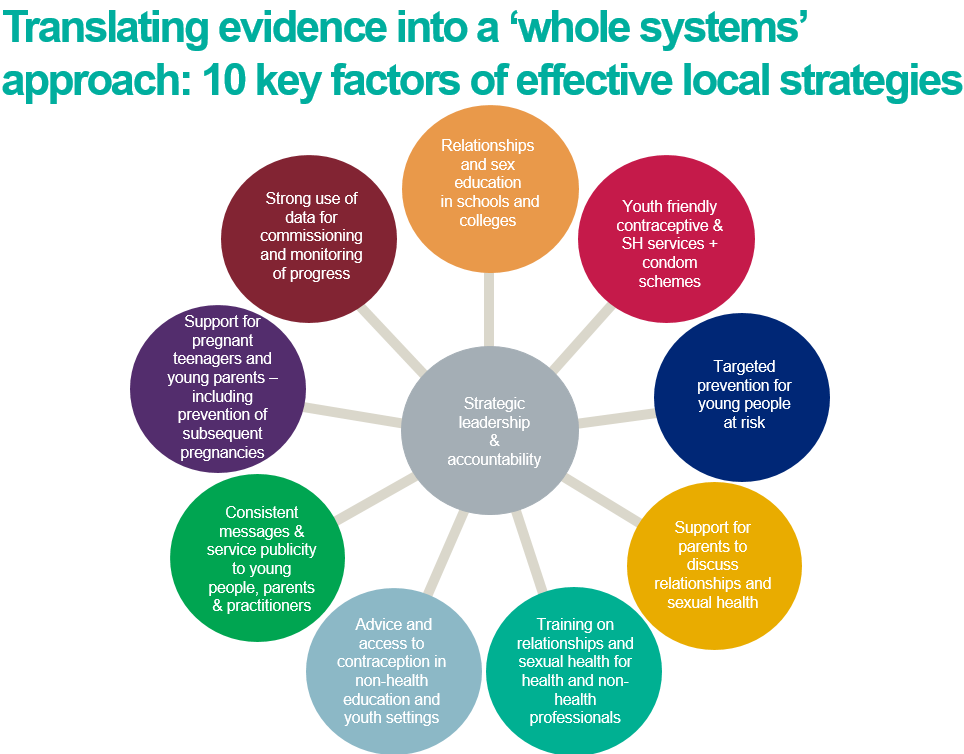
The international evidence for reducing teenage pregnancy is clear. Building the knowledge, skills, resilience and aspirations of young people and providing easy access to welcoming services, helps them to delay sex until they are ready to enjoy healthy, consensual relationships and to use contraception to prevent unplanned pregnancy. An open culture and ease of parental communication around sexual issues are also associated with lower teenage pregnancy rates. Evidence and learning has shown that partnership working is vital. For effective local delivery, health, education, social care and safeguarding agencies need to understand the relevance of healthy relationships and teenage pregnancy to their own priorities, and how they can contribute to the solution. In the same way that effective relationships and sex education needs a ‘whole school’ approach to provide a positive and supportive environment outside the classroom, and building young people’s resilience needs a family, community and service response, prevention of teenage pregnancy also requires a whole system approach. So there is no ‘wrong door’ for a young person seeking advice. Having a trusted adult to turn to on personal issues is protective for young people on a number of health and emotional outcomes.
The Office for Health Improvement & Disparities (formerly Public Health England) have recommended a ‘whole systems’ approach.
Resources
Ermisch, J. Does a ‘teen birth’ have longer term impacts on the mother? Suggestive evidence from the British Household Panel Study. ISER Working Papers Number 2003-32. Institute for Social and Economic Research: London, 2003.
Department for Education and Skills, Teenage pregnancy: accelerating the strategy to 2010. Department for Education and Skills: London, 2006.
The Office for Health Improvement & Disparities’ Fingertips: https://fingertips.phe.org.uk/
Office for National Statistics. Conception statistics, England and Wales, 2022: www.ons.gov.uk
The Office for Health Improvement & Disparities (formerly Public Health England). Teenage pregnancy prevention framework. https://www.gov.uk/government/publications/teenage-pregnancy-prevention-framework
The Office for Health Improvement & Disparities (formerly Public Health England). Teenage pregnancy prevention framework (Powerpoint presentation).
Updates
This page was last updated / checked on 12 March 2026.
This page is due to be updated / checked in April 2026.